
Architecture
Core Components
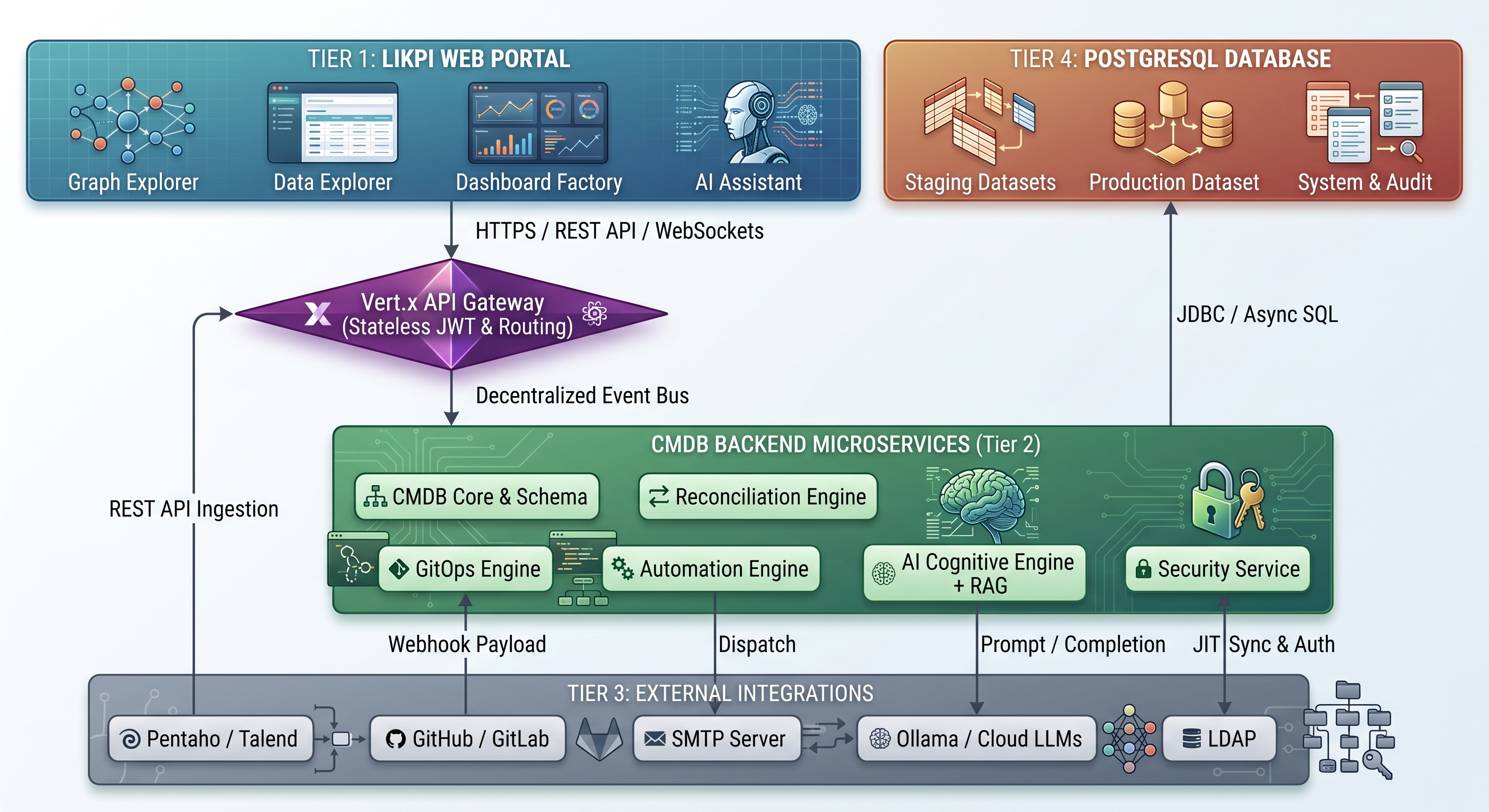
Backend Services
API Gateway & Router
The Vert.x-based non-blocking API gateway manages all inbound REST requests. It handles stateless JWT authentication, routes payloads to appropriate services, and ensures high concurrency.
PostgreSQL Database
This database stores all Configuration Items (CIs), relationships, and system configurations. It leverages advanced JSONB capabilities for schema-less custom attributes and native table partitioning to isolate environments (e.g., PRODUCTION vs. SANDBOX).
Reconciliation Engine
This component acts as the brain of the CMDB, deduplicating incoming data using Identification Rules and resolving conflicts via a granular Attribute-Level Precedence and Time-Decay Aging system.
GitOps Engine
This service listens for webhooks directly from Git providers (GitHub, GitLab, Bitbucket). It securely fetches declarative YAML manifests, validates them against the active schema, and stages them for automated integration.
Trigger & Activity Engines
These components form the event-driven automation layer. They continuously listen to the Event Bus for CI state changes and automatically execute triggered actions (like webhooks or notifications) or schedule background jobs.
AI Cognitive Engine
A dual-model artificial intelligence service. It routes complex Natural Language to SQL (NL2SQL) translations to a heavy reasoning model, and fast data summarization tasks to lighter, faster local models.
IAM & Security Service
Handles identity synchronization via LDAP/AD, validates JWT sessions, and enforces Multi-Tenant Row-Level Security (RLS) dynamically using Visibility Profiles and Group mappings.
Likpi Web Portal Modules
Graph Explorer
An interactive topological canvas that allows users to visualize CI dependencies, apply algorithmic layouts, and perform multi-node selections using a Lasso tool.
Data Explorer
This module provides a tabular view to quickly access and search all CIs and Relations. It features a Custom Query Builder for complex filtering and allows users to save custom search profiles.
Dashboard Factory & Viewer
A drag-and-drop workspace that helps the administrator to easily create real-time analytics dashboards composed of SQL-driven widgets (Scalars, Pie Charts, Bar Charts, Line/Curve Histograms, Radar Charts, and Tables).
AI Assistant
An integrated conversational interface (Copilot) where users can ask natural language questions about their infrastructure, instantly receiving textual summaries and visual charts.
GitOps Audit Dashboard
This module tracks all infrastructure-as-code deployments in real time. It flags schema compliance violations, detects topological blast radius impacts (orphaned CIs), and provides an AI auditor for root-cause analysis.
Data Models Governance
This wizard allows administrators to abstract live operational graphs into reusable Enterprise Architecture blueprints. It supports formal approval workflows and exports boardroom-ready PDF documentation.
Class & Relation Registry
A configuration suite to visually manage the CMDB ontology. Administrators can define new CI Classes and Relation Types, alongside dynamic attributes like Strings, Booleans, Dates, and CLOB_History logs].
Standard Catalog (Criteria Manager)
This module manages the permitted taxonomy rules (Category, Type, Item, Model) to ensure infrastructure definitions remain standardized, and actively scans for orphaned assets.
Identification Rules Manager
Allows administrators to define the exact combinations of attributes required to uniquely identify and deduplicate incoming CIs during the ingestion process.
Attribute Precedence Manager
Provides the ability to manage data source priorities at the Dataset, Class, or specific Attribute level, ensuring the most trustworthy data builds the Golden Record.
Dataset Manager
This form allows you to govern isolated data environments (e.g., SANDBOX vs PRODUCTION) to safely stage integrations before they affect the live operational state.
Trigger & Lifecycle Managers
These modules allow you to define event-driven automation rules based on CI modifications, and set automated data aging policies to soft-delete or hard-delete stale assets.
Groups & Users
This module allows you to manage your system users, Roles (Admin, Editor, Viewer), and Active Directory/LDAP mappings. It also governs tenant access by linking groups to specific organizations and visibility profiles.
System Configuration & License
A centralized administrative panel to manage global polling timers, memory batch sizes, SMTP email notifications, dual-engine AI prompts, and enterprise license quotas.